Alibaba Review 2026: Is It Safe & How to Buy (Step by Step)
By Zack · Published
In this guide
Quick verdict (the 60-second answer)
Yes — Alibaba.com is safe to buy from in 2026, but only if you follow three rules: (1) only pay inside Alibaba.com’s Trade Assurance escrow, (2) only order from suppliers with a third-party Verified Supplier / A&V report, and (3) budget for the new tariffs instead of the 2021 price you remember. Alibaba.com is the world’s largest B2B marketplace (50M+ active buyers, 200+ countries, 200K+ Trade Assurance suppliers), and it works extremely well for $2,000–$100,000 orders. It works badly for single-item retail purchases, for buyers who pay suppliers off-platform, and for anyone who still assumes “Made in China” means “duty-free into the US.”
Safety score: 8/10 on-platform · 3/10 off-platform. Read the 7-step buying process and the 2026 cost reality check before you wire a single dollar.

What Alibaba.com actually is in 2026
Most “Alibaba review” articles fail because they review the company instead of the buying experience. Alibaba Group is a conglomerate; Alibaba.com is one specific B2B marketplace inside it, and it is the only one built for wholesale importing.
Here is the map most buyers need before anything else:
| Platform | What it is | Who it’s for | Typical order | Payment protection |
|---|---|---|---|---|
| Alibaba.com | B2B wholesale marketplace, 200+ countries, 280M+ products | Importers, wholesalers, brands, Amazon sellers | $1,000–$100,000+ | Trade Assurance escrow |
| AliExpress | B2C retail arm of the same group | Consumers, dropshippers testing products | $1–$200 | Buyer protection, 30–90 days |
| 1688.com | Domestic China wholesale site | Chinese buyers (Chinese-language, RMB) | Any | Not designed for export |
| Taobao / Tmall | Domestic China retail | Chinese consumers | $1–$500 | Not designed for export |
| DHgate | B2B/B2C hybrid, smaller sellers | Very small test orders | $50–$2,000 | Weaker dispute handling |

Scale, as published by Alibaba.com in 2026:
- 50M+ active buyers sourcing from verified suppliers
- 200+ buyer countries and regions
- 200K+ Trade Assurance suppliers
- 280M+ products listed
- 500K+ RFQs (Request for Quotation) posted daily — the single most under-used feature by new buyers
One structural change matters more than any of those numbers: Alibaba.com is now an AI-first sourcing platform. The 2021 version of this page described a directory with a search bar. The 2026 version has AI search that reads your sourcing intent, an RFQ marketplace that runs a reverse auction on your behalf, and Accio Work, Alibaba’s agentic AI business team that can draft specs, shortlist suppliers and negotiate first-round terms around the clock.
That is good news for buyers — and it is also why a 2021 review is now actively misleading.
Is Alibaba safe? The honest 2026 answer
I have been sourcing in Yiwu and Shantou since 2012 and I have run my own orders through Alibaba.com for over a decade. Here is the honest split.
What is genuinely safe in 2026:
- Money is held in escrow. When you pay on Alibaba.com, the supplier does not get your money when you click “pay.” They get it after delivery is confirmed. This single mechanic removes 80% of the classic “supplier took my deposit and vanished” risk.
- A 30-day post-delivery refund window. If product quality or ship date differs from what was agreed in the Trade Assurance order, you can file for a refund within 30 days of delivery. Alibaba investigates, mediates and can refund.
- Third-party supplier verification. Verified Suppliers have been inspected by independent institutions such as SGS, TÜV Rheinland and Intertek, and publish an assessment report plus 360° on-site factory videos. That is a real audit trail you can read before you send an inquiry.
- Multiple payment rails. Credit/debit card, PayPal, Apple Pay, wire transfer through Alibaba.com and digital wallets — all processed inside the platform.
What is still risky — and always has been:
- Paying off-platform. The moment you pay a supplier’s personal PayPal, Western Union, a Hong Kong bank account or crypto, every protection disappears. No escrow, no dispute, no refund. This is where nearly every “Alibaba scam” story actually begins.
- Quality that is “fine” but not what you pictured. Trade Assurance protects you against a documented deviation from agreed specs. It does not protect you against a supplier who met the letter of a vague spec. Vague specs are the #1 cause of disputes I see.
- Intellectual property risk. If your product carries a licensed character, logo or patented design, you must obtain a letter of authorisation from the rights holder. Alibaba will not do this for you, and customs seizure is the buyer’s problem, not the platform’s.
- Trading companies posing as factories. A large share of “manufacturers” on any marketplace are actually traders. That is not automatically bad — but it changes your price structure and your leverage, so ask directly.
Bottom line: Alibaba.com is one of the safest ways to buy from China. It is not a substitute for due diligence, and it cannot save you from a bad spec sheet.
How Trade Assurance really protects you
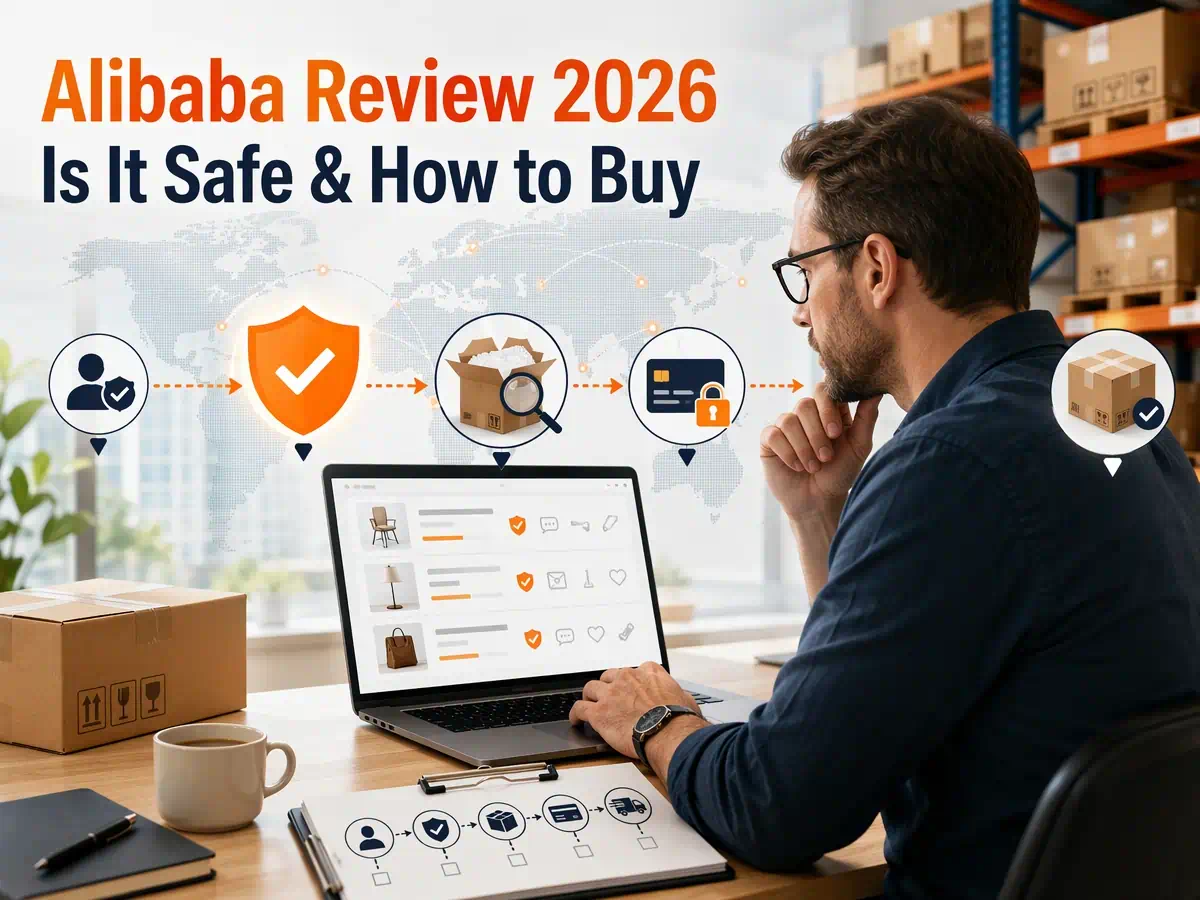
Trade Assurance is the feature that makes the whole platform work, so it is worth understanding precisely. The official flow:
- You agree an order with a Trade Assurance supplier (product, spec, quantity, price, ship date — all written into the online order).
- You pay through Alibaba.com by card, PayPal, wire transfer or wallet.
- Payment is held in escrow.
- Funds are released to the supplier only after you receive and confirm the goods.
- If the terms are not met, Alibaba mediates and can issue a refund or compensation.
What is covered: secure and diverse payment options, a money-back policy, shipping and logistics services, and after-sales protections. What is not covered: anything paid outside the platform, and quality that was never written into the order in the first place.
The pro tip almost nobody follows: the Trade Assurance online order is your contract. Buyers who write “high quality plush toy, EN71 compliant, 30cm, fill 100% PP cotton, no shedding, packaging: color box with hangtag” get protected. Buyers who write “plush toy as discussed” get nothing. Spend 30 extra minutes on the order terms — it is the cheapest insurance in importing.
Trade Assurance also expanded in 2025–2026 beyond its original markets, with launches in South Korea (Dec 2025) and Indonesia (Apr 2026) — a signal that Alibaba is pushing the same buyer-protection standard into growth markets.

How to buy from Alibaba in 2026: the 7-step process
This is the process I teach buyers, updated for the 2026 platform. It assumes you are sourcing a private-label or custom product — the highest-risk, highest-margin path.
Step 1 — Define the product spec before you search
Write down: material, dimensions, weight, colour standards (Pantone if relevant), packaging, certifications required in your market, target FOB price, and annual volume. Suppliers respond to specificity. “I need a quote for a toy” gets you a template reply; “28cm plush dinosaur, short-pile polyester, EN71-1/2/3 + CPSIA test reports, color box, 3,000 pcs, target FOB $2.80” gets you a real price.
Step 2 — Use AI search and the RFQ marketplace
Do both. Run your product through Alibaba’s AI search, then post an RFQ with your full spec. With 500K+ RFQs posted daily you are competing on clarity, not luck. A well-written RFQ pulls in 5–15 qualified quotes within days. Tools like Accio Work can draft the RFQ, translate it and run first-round supplier screening for you — useful if English is not your first language or you are sourcing while sleeping.

Step 3 — Shortlist only verified suppliers, then read the evidence
Filter for:
- Verified Supplier badge (third-party inspection, not self-declared)
- Trade Assurance badge
- Assessment report + 360° factory video — actually open it. Look for their own production line, QC station and warehouse. A report with no machinery is a trading company.
- Years as a supplier, response rate, repeat-buyer ratio
- Whether their export experience covers your destination market

Step 4 — Order a paid sample. Always.
A sample costs $30–$150 plus shipping. A bad production run costs thousands. Rules I never break:
- Pay the sample fee on-platform (never to a personal account).
- Specify exactly what the sample must demonstrate.
- Ask for a pre-production sample approval process in writing: “no mass production before I approve the golden sample.”
- If a supplier refuses to send a sample at all, walk away. That is a red flag, not a negotiating position.

Step 5 — Compare landed cost, not unit price
Never award an order on FOB unit price alone. Build a landed-cost sheet: FOB price + freight + insurance + duty (check your HTS code) + MPF/brokerage + inspection + any agent fee. Two quotes can differ by 40% on unit price and 5% on landed cost once freight and duty are included. (See the cost breakdown below.)
Step 6 — Pay on-platform, with a staged structure
Standard structure for a first order:
- 30% deposit, 70% balance against B/L copy — all paid inside Trade Assurance.
- For larger or repeat orders, ask about Pay Later (currently open to US buyers; credit lines up to $150,000, terms up to 6 months, promotional rates from 1.25% in the first month) or Payment Terms (60-day terms, 2.2% service fee on the balance, minimum 30% deposit). Financing terms are now a real negotiating lever with suppliers, because they de-risk the supplier’s cash flow too.
- Never accept “we give you 5% off if you pay to our private account.” That discount is the most expensive money you will ever save.
Step 7 — Inspect before you ship, then control the logistics
Two options:
- Third-party inspection (SGS/QIMA/AsiaInspection-style) at the end of production, before balance payment.
- Your own agent on the ground. This is what my team does in Yiwu and Shantou: we check the finished goods against the golden sample before the container is sealed.
Then agree Incoterms explicitly. FOB is usually the right choice for new buyers — the supplier handles export clearance and Chinese charges, and you control the main freight. Ask about import duties before you order, not after the goods arrive.
What changed in 2026 that buyers must know
This is the section that makes a 2021 review obsolete. Three shifts changed the economics of buying from China.
1. AI moved from “search box” to “sourcing team”
Alibaba.com’s AI layer now covers supplier matching, listing quality, RFQ drafting and first-round negotiation. For a small buyer, the practical effect is that the barrier to sourcing well is no longer language or contacts — it is spec clarity and verification discipline. The buyers who win in 2026 write better specs and read verification reports. Everyone else gets a cheaper price and a worse product.
2. Tariffs and de minimis changed the landed-cost math — badly
If your last China import model was built before 2025, it is wrong. The current picture for US-bound goods, as of late 2026:
Change What happened Practical effect $800 de minimis suspended Duty-free treatment for shipments under $800 was suspended for all countries from 29 Aug 2025; extended by further orders and Federal Register rules in 2026, with no restoration date Small parcels no longer enter duty-free. Dropship-from-China models must be re-costed Postal flat-tax window closed The temporary flat per-item postal rates ended 28 Feb 2026 Postal parcels are now taxed on value Section 301 forced-labor duty A 12.5% duty on China-origin goods took effect 24 Jul 2026 (steel/aluminium, semiconductors, vehicles and medicines exempt) Stacked on the existing 25% Section 301 duties, many consumer goods now face 37.5% IEEPA tariffs invalidated, refunds running The US Supreme Court invalidated the IEEPA tariffs; CBP began refund processing for importers of record via the CAPE platform from 20 Apr 2026 If you imported in 2025, you may be owed a refund — ask your broker EU de minimis removed The EU removed its €150 threshold from 1 Jul 2026 Europe is no longer a “cheap small-parcel” destination either Exclusions still moving 178 Section 301 exclusions were extended only to 9 Nov 2026 Check your HTS code every quarter; do not assume last year’s exclusion still applies Combined duty on some consumer categories now exceeds 50% once MFN, Section 301, forced-labor and other layers stack. Two consequences for buyers:

- Consolidate. The math now favours fewer, larger shipments. Splitting an order into ten air parcels destroys margin; one consolidated LCL or FCL spreads fixed costs.
- Verify the HTS code, not the headline. A 37.5% headline rate may be 25% for your product if it sits on an exclusion list — or 55% if you stacked two programmes and never checked. Use the USITC HTS search and have a customs broker confirm before you commit.
The official tariff tools I actually use — all free, all authoritative:
| Market | Tool | What it answers |
|---|---|---|
| US | USITC HTS Search | The binding US tariff schedule: MFN rate, Chapter 99 notes, and the Section 301 / forced-labor duties attached to your exact 10-digit code |
| US | CBP Trade Portal | Entry requirements, MPF and brokerage, informal vs formal entry, current procedural guidance |
| US | USTR Section 301 Actions | Whether your product sits on a 301 list, and which exclusions are still in force |
| US | Federal Register | The actual orders behind every headline — de minimis, IEEPA, exclusion extensions |
| EU | Access2Markets | EU duty rates, import VAT and the post-de-minimis rules for low-value parcels |
| UK | UK Trade Tariff (HMRC) | UK commodity codes, third-country duty rates and tariff preferences |
Search tip: start from the HS code printed on your supplier’s quotation, confirm it yourself in the schedule, then read the Chapter 99 notes — that is where the extra 25% and 12.5% actually live. A two-minute lookup beats a five-figure surprise at the port.
3. Payment terms became a competitive tool
Pay Later and 60-day Payment Terms are now available to US buyers, which means cash-flow terms are negotiable in a way they were not in 2021. Use them — but model the fee (from ~1.25% first month, or 2.2% on the balance for 60-day terms) into your unit cost before you accept.
Alibaba.com vs AliExpress vs DHgate vs 1688 vs a sourcing agent
| Alibaba.com | AliExpress | DHgate | 1688.com | Sourcing agent | |
|---|---|---|---|---|---|
| Built for | B2B wholesale import | B2C retail | Small B2B/test orders | Domestic China trade | Custom projects |
| Min. order | 50–1,000+ pcs (negotiable) | 1 pc | 1–10 pcs | 1 pc (RMB, Chinese) | Any |
| Price | Near-factory | Retail-marked-up | Mid | Lowest of all | Factory + 5–10% fee |
| Buyer protection | Escrow + 30-day refund | Buyer protection | Weaker | None for foreigners | Contract + on-ground QC |
| Best at | Custom/OEM, repeat orders | Product validation | Tiny test orders | Chinese-speaking buyers | Quality control, audits, mixed orders |
| Worst at | Very small orders | Customisation | Disputes | Language/payment/export | Cost, for simple repeat buys |

My rule of thumb: validate a product on AliExpress, scale it on Alibaba.com, and hand the quality control to a local agent once your order passes $10,000 or your product needs compliance documents (CE, EN71, CPSIA, CPC).
If you are weighing a specific head-to-head, we have a full breakdown of DHgate vs Alibaba and a step-by-step guide to buying from Alibaba safely.
The real cost of buying from Alibaba in 2026
Here is a realistic cost stack for a $10,000 wholesale toy order (3,000 units at $3.33 FOB) shipped to a US buyer in late 2026. Use it as a template and plug in your own numbers.
| Cost line | Typical range | Notes |
|---|---|---|
| Product (FOB) | $10,000 | The number on the quotation — never the final number |
| Sample + courier | $80–$250 | DHL/FedEx, 2–4 days |
| Ocean freight (LCL/FCL) | $600–$1,800 | ~$0.15–$0.60/unit at this volume; air is 5–10× |
| Duty | $2,500–$5,500+ | Section 301 (25%) + forced-labor (12.5%) + MFN. Check your HTS code |
| MPF + brokerage | $150–$400 | Informal entry ≤$2,500; formal entry above |
| Compliance testing (if needed) | $300–$1,200 per SKU | EN71 / CPSIA / CPC reports — see our testing-lab guide |
| Third-party inspection | $150–$350 | Strongly recommended on first orders |
| Realistic landed cost | ~$13,800–$19,500 | i.e. 1.4×–1.9× the FOB quote |
The lesson: in 2026 the FOB price is roughly half the story. Buyers who quote retail prices off the Alibaba unit price are the ones who go broke in year two.

For a deeper dive into how quotes are built and how to read them, see how to check a toys quotation list, and for mixed-category orders, our breakdown of Yiwu toy prices and MOQs.
Alibaba scams and red flags (from 14 years of sourcing)
Alibaba.com itself is not a scam. But every marketplace has bad actors, and these are the patterns I have seen most often:
- “Pay to my private account for a discount.” The single biggest loss event in China sourcing. Never do it.
- Price far below the market floor. A price 40% under the next three quotes means a different material, a different factory, or no factory at all.
- Refusing to send a sample. Legitimate factories send samples; it is how they win orders.
- No video call, ever. Ask for a live walkthrough of the production line. A real factory says yes in five minutes.
- Vague specs accepted without questions. A supplier who never asks about tolerances, packaging or certifications either has not read your spec or is planning to substitute materials.
- Pressure to skip the sample / skip inspection / “ship immediately to get the price.” Urgency is a sales tactic.
- Company age younger than your project timeline. A supplier registered four months ago taking a $50,000 first order is a risk, not an opportunity.
- Branded product without authorisation. If the listing shows a licensed character, ask for the letter of authorisation. Without it you are buying a customs seizure.

Your five-point verification routine: Verified Supplier badge → read the assessment report → live video call → paid sample via Trade Assurance → pre-shipment inspection. If a supplier passes all five, your risk of a catastrophic loss is very low.
Is Alibaba right for your business?
Use this decision framework:
Alibaba.com is the right channel if you:
- Order 50–5,000+ units per SKU
- Need customisation: logo, packaging, colour, material changes (see factory OEM)
- Can commit to a 30% deposit / 70% balance structure
- Sell on Amazon, in retail, or run a wholesale brand
- Have (or can hire) someone to write specs and check quality
Look elsewhere if you:
- Need 1–20 units → AliExpress, or a Yiwu agent for mixed orders
- Need a one-off sample → AliExpress or a sample-sourcing service
- Cannot pay on-platform at all → no channel is safe, not just Alibaba
- Need guaranteed compliance documents (CE/EN71/CPSIA) → a factory-direct sourcing project with lab testing, not a marketplace listing
When you should hire a sourcing agent instead
Alibaba.com is a marketplace, not a partner. It will not visit the factory, open the carton before the container is sealed, or argue with a supplier on your behalf. That is the gap a local agent fills.
You should hire an agent when any of these is true:
- Your order value passes $10,000–$15,000 and a quality failure would wipe out a season
- You need compliance documents (CE, EN71, CPSIA, CPC) verified against real test reports, not PDFs forwarded by a trader
- You are combining multiple suppliers or categories into one shipment — this is exactly what Yiwu is built for
- You are sourcing factory-direct in Shantou/Chenghai and need someone who knows which of the lookalike showrooms actually owns a moulding line
- You have been burned before and want one accountable point of contact from sample to container
That is what my team does: compare 3–5 qualified suppliers on quality, price, MOQ, compliance capability and lead time, verify the claims that cannot be verified from a listing, inspect before shipment, and consolidate and ship through one contact. If that sounds like your situation, send us your sourcing requirement and we will tell you honestly whether Alibaba.com alone is enough.
Related reading on this site:
- How to buy from Alibaba safely: the full guide
- DHgate vs Alibaba: which is better for wholesale?
- Yiwu toy prices and MOQs explained
- How to arrange a container shipment from China
- Toy testing labs and certification: CE, EN71, ASTM, CPSIA
FAQ
Is Alibaba safe to buy from in 2026? Yes, provided you pay only through Alibaba.com’s Trade Assurance escrow and order from verified suppliers. Payments are held in escrow and released after you confirm delivery, and you have a 30-day post-delivery window to file a quality or ship-date claim. The risk appears when buyers pay suppliers off-platform, which voids all protection.
Is Alibaba.com the same as AliExpress? No. Alibaba.com is the B2B wholesale marketplace for importers (larger orders, customisation, escrow). AliExpress is the consumer retail arm, built for single-item purchases. Same group, completely different purpose.
Does Alibaba charge buyers a fee? Buying on Alibaba.com is free — there is no buyer membership fee. Costs come from payment-processing fees on certain methods, and optional financing (Pay Later or 60-day Payment Terms, priced separately). Always confirm the fee schedule for your payment method before checkout.
Can I buy just one item from Alibaba? You can, but it is usually poor value. Alibaba.com suppliers set MOQs, often 50–1,000 units, and a single unit rarely justifies the sample, freight and compliance cost. For one-off purchases, AliExpress is the better fit.
What is the minimum order quantity (MOQ) on Alibaba? MOQs are set per supplier and range from a few dozen units on stock items to 1,000+ on custom OEM products. MOQs are negotiable, especially for stock products in Yiwu, where mixed-SKU and mixed-supplier orders are common.
Can I use PayPal on Alibaba.com? Yes. PayPal is supported, and for Trade Assurance orders you are protected once the payment is completed online through Alibaba.com using PayPal. Apple Pay, cards, wire transfer and digital wallets are also supported.
What happens if my supplier does not ship? If the order was placed under Trade Assurance and paid on-platform, file a dispute. Alibaba mediates and can refund or compensate if the supplier fails to meet the agreed ship date or product terms. If you paid off-platform, there is effectively no recourse.
How long does shipping from Alibaba take? Air freight is typically 5–10 days; ocean LCL/FCL is roughly 25–40 days door to door depending on the route and season. Suppliers quote 7–15 days for ready-to-ship stock, and 30–60 days for custom production.
Do I need a company to buy from Alibaba? No, individuals can buy. But you will need a customs broker or importer of record arrangement for commercial shipments, and a business entity makes compliance, financing and repeat ordering significantly easier.
Is Alibaba cheaper than buying from a local wholesaler? On unit price, usually yes. On landed cost after duty, freight, inspection and compliance, sometimes not — especially at low volumes. Run the landed-cost sheet before you assume the saving.
Are Alibaba suppliers factories or trading companies? Both. Roughly speaking, the “Verified Supplier” reports that show production machinery, QC stations and a 360° factory video indicate a manufacturer; reports without them usually indicate a trading company. Neither is automatically disqualifying, but the distinction changes your price and your leverage.
Final verdict
Alibaba.com in 2026 is a better platform than the one this review originally covered: stronger verification, escrow-based protection, AI-assisted sourcing, and financing options that did not exist five years ago. It is also a harder market to profit in, because the tariff regime has quietly raised the true cost of every China-origin order by 25–50% or more.
The platform rewards buyers who treat it as a supply-chain tool rather than a shopping website: write precise specs, verify the factory, pay on-platform, inspect before shipment, and model landed cost instead of unit price. Do those five things and Alibaba.com remains the most efficient way to buy from China at scale.
Next step: if you want a second pair of eyes on your first order, send us your product spec and target price — we will tell you which suppliers are worth quoting and what the realistic landed cost looks like for your market.